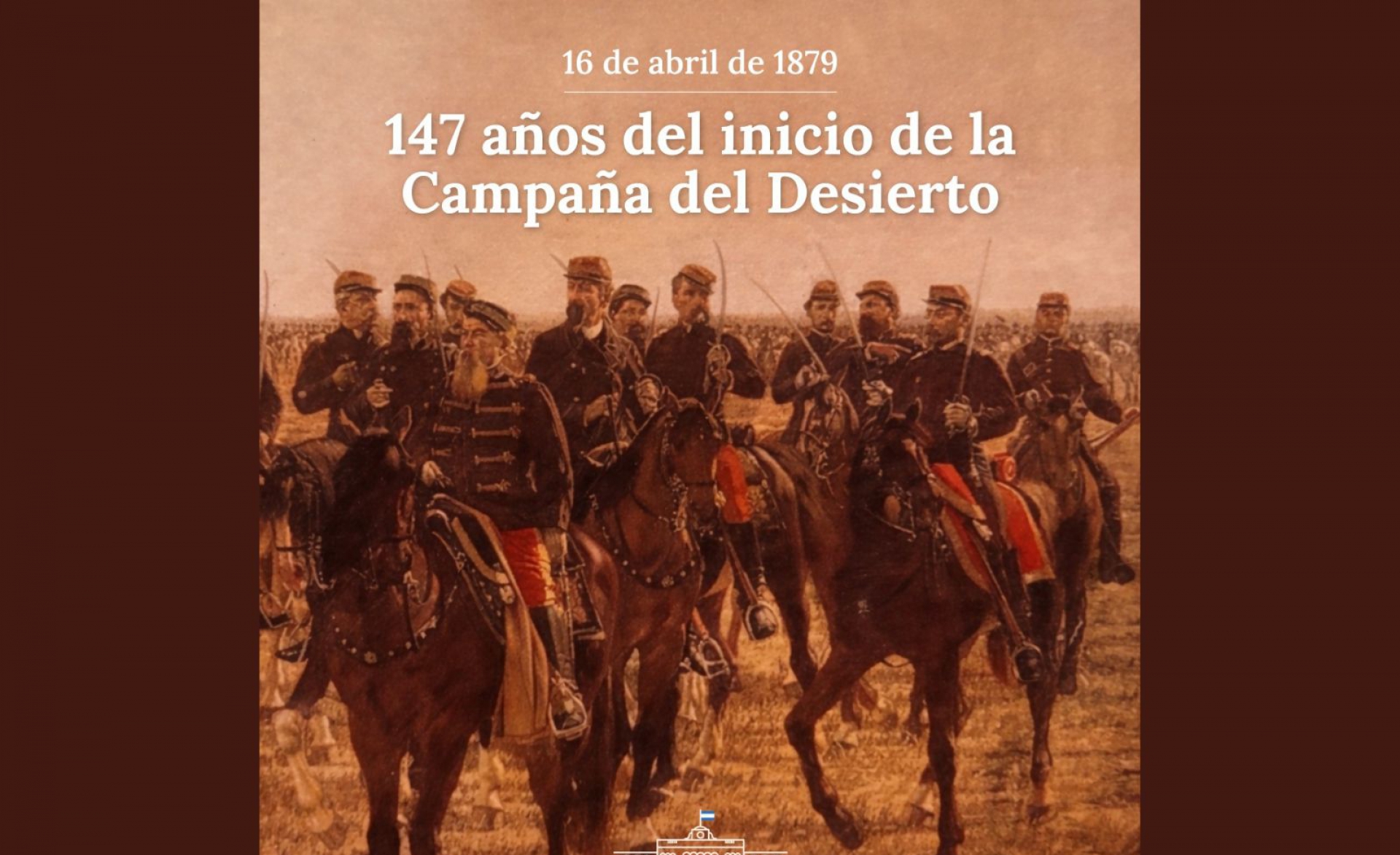
On 16 April 1879, the Desert Campaign began, a military operation organised by the Argentine State that would mark a turning point in the process of territorial expansion towards the south of the country. Under the command of the then Minister of War and the Navy, the National Hero Julio Argentino Roca, a large-scale strategy was deployed with the aim of establishing state control over vast regions considered to be frontier territories.
The offensive took place during the presidency of Nicolás Avellaneda and forms part of a broader historical process, which included previous expeditions driven by both provincial and national governments. However, the 1879 campaign was the most decisive: it enabled the consolidation of state control over much of Patagonia and the redefinition of the country’s territorial boundaries.
The military advance made it possible to incorporate vast tracts of land into the national territory, whilst reinforcing a model of organisation based on territorial expansion, the institutionalisation of the newly incorporated areas, and the promotion of an agro-export economy. In this sense, the campaign contributed significantly to the consolidation of the modern nation state, expanding its capacity for control, administration and territorial projection.
147 years on from the start of the Desert Campaign, we commemorate this fundamental milestone in our nation’s history, which signified not only the expansion of the national territory, but also the establishment of the modern Argentine state.