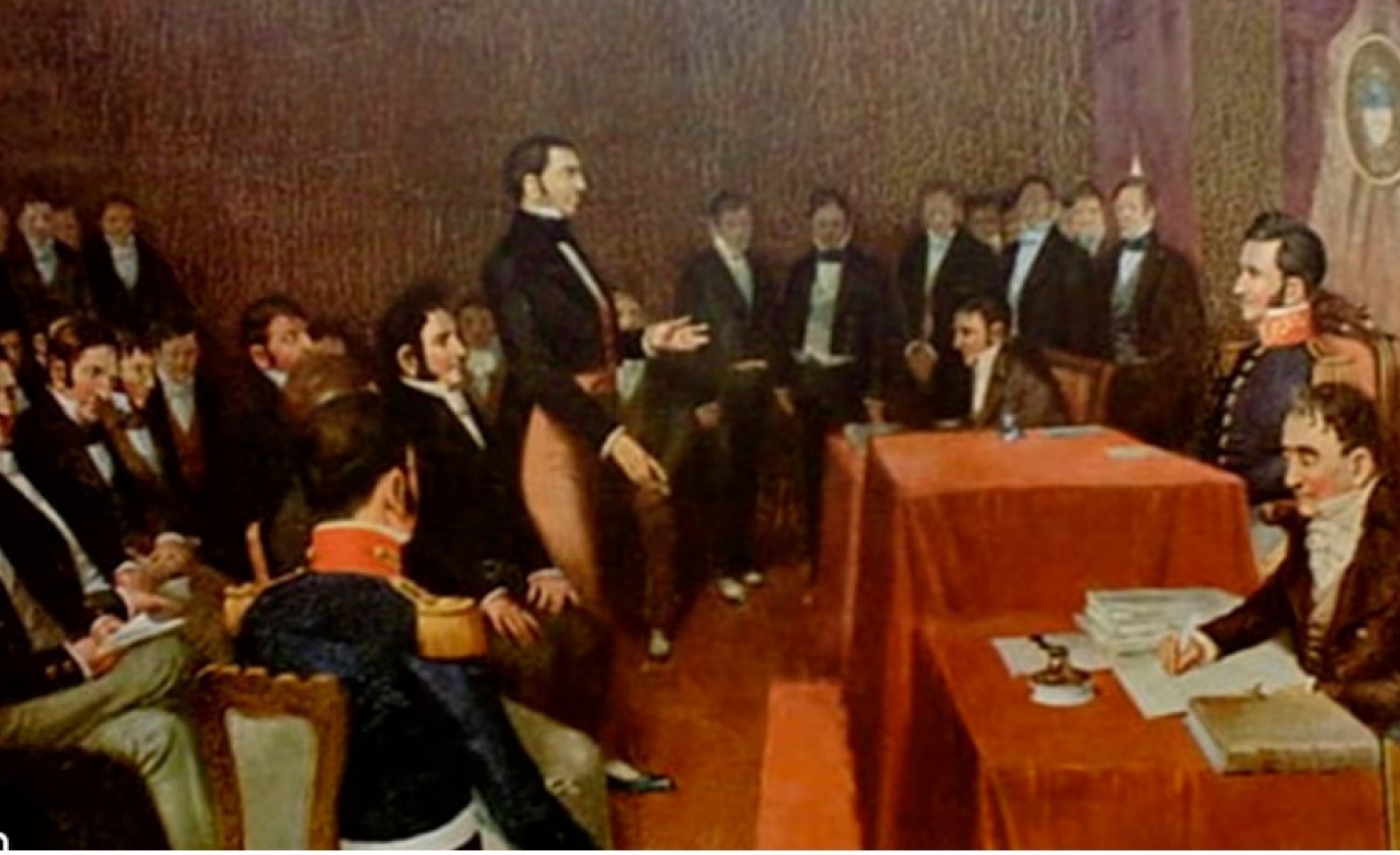
On 31 January 1813, the sessions of the Constituent General Assembly, historically known as the Assembly of Year XIII, were inaugurated. It was convened in a context of profound political transformation, marked by Manuel Belgrano's victory in the Battle of Tucumán and the consequent discrediting of the First Triumvirate, which was questioned for its lack of support for the Army of the North. Pressure from the Lautaro Lodge led to the formation of a Second Triumvirate, whose main decision was to promote this first assembly experience for constitutional purposes.
The Assembly declared itself sovereign and assumed the representation of the provinces, with an explicit purpose: to declare independence and politically organise the Viceroyalty of the Río de la Plata through the enactment of a Constitution. In a climate of growing revolutionary radicalisation, it adopted measures with a high political and social impact. The oath of allegiance excluded loyalty to King Ferdinand VII and provided for freedom of the press, freedom of wombs, the abolition of the indigenous tribute, the mita, the yanaconazgo and personal service, as well as the suppression of titles and signs of nobility and the elimination of entailed estates.
However, the Assembly failed to achieve its two main objectives: formally declaring independence and enacting a constitution. This was due to both internal tensions and the adverse international context. By 1814, the restoration of Ferdinand VII to the Spanish throne and the threat of a military offensive against the American territories weakened the revolutionary momentum, paralysing the functioning of the body until its dissolution.
Despite its limitations, the Assembly of Year XIII adopted decisions that implied true ‘de facto independence.’ These included the creation of the National Coat of Arms to replace the Spanish royal coat of arms; the approval of the Argentine National Anthem, with lyrics by Vicente López y Planes and music by Blas Parera; the declaration of 25 May as a civic holiday; the removal of the king's effigy from coins, replaced by the seal of the United Provinces; and the prohibition of corporal punishment in schools.
The Assembly was finally dissolved in April 1815, two years and three months after its establishment. The new political objective was to convene a congress to realise the remaining aspirations: the declaration of independence and the constitutional organisation of the country. This purpose would be realised at the Congress of Tucumán, which met on 24 March 1816. The goal of independence was achieved on 9 July of that year, but national organisation remained pending, which was only achieved thirty-seven years later with the enactment of our National Constitution.
Two hundred and thirteen years after the start of the Assembly of Year XIII, its legacy endures as a fundamental milestone, laying the political and symbolic foundations that contributed to the sovereignty and construction of our country.